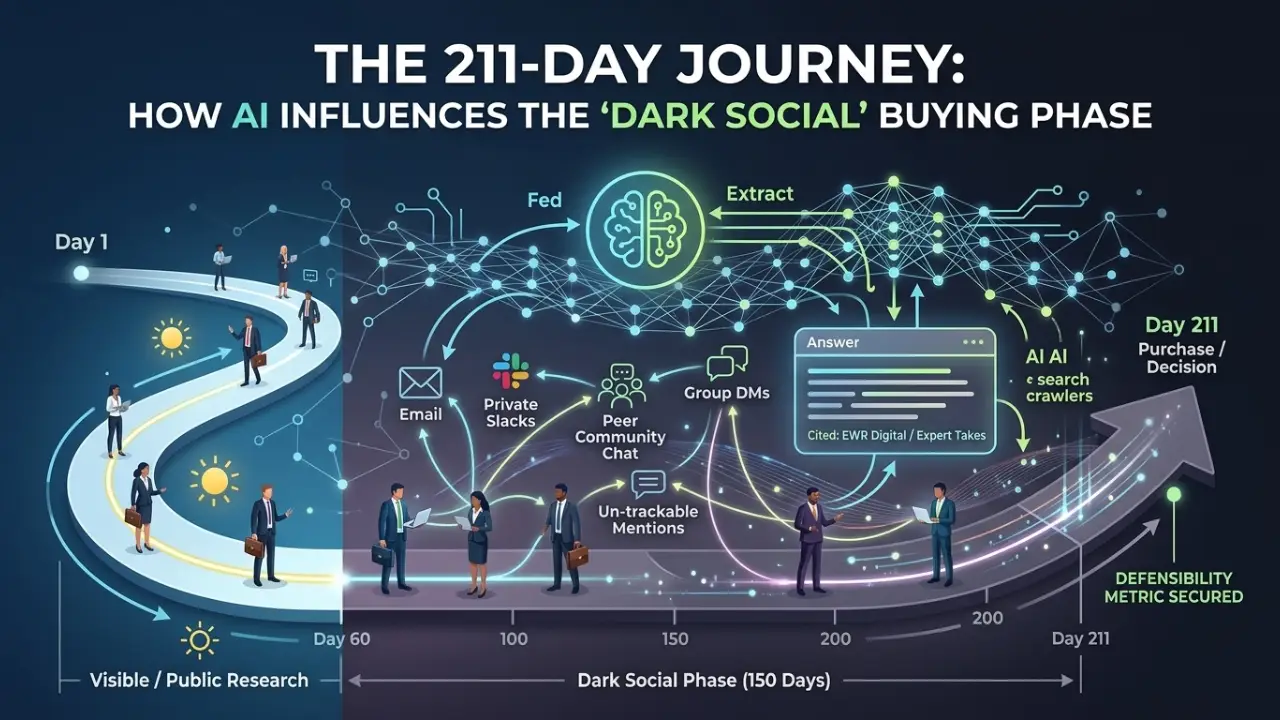
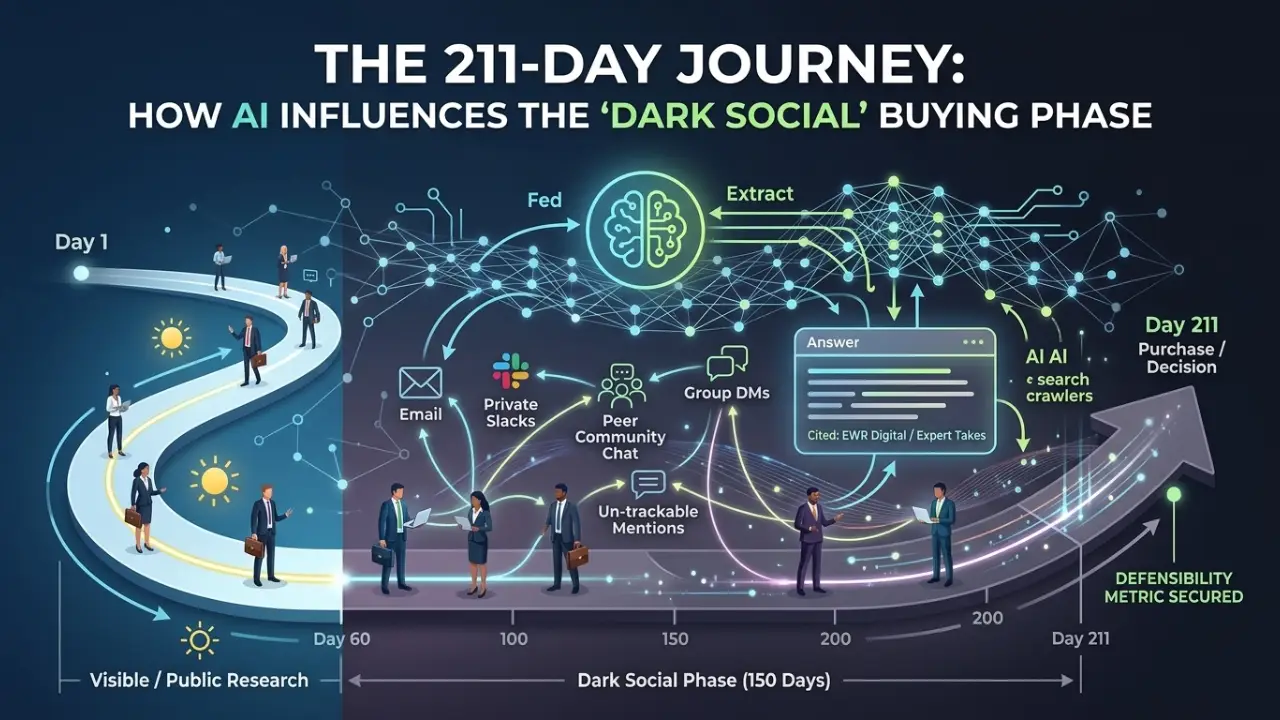
The traditional B2B sales funnel has been dismantled. Today, the modern enterprise purchasing cycle spans an average of 211 days, and roughly 70% of that entire timeline occurs completely outside of your visible sales pipeline. This invisible timeline represents the dark funnel, a space where buying groups conduct extensive, self-directed research before ever filling out a contact form or speaking with a sales representative. As we navigate 2026, the primary tools driving this covert evaluation period are no longer standard search engines alone. Instead, enterprise buyers are using generative platforms like Perplexity, ChatGPT, and Gemini to vet vendors. To capture demand before a prospect ever speaks to your sales team, implementing a data-backed B2B content strategy is critical to ensuring your brand is synthesized accurately by generative models during this critical phase of dark social discovery.
Demystifying the 211-Day B2B Buying Process in the Generative Era
The realization that a buyer spends over 150 days investigating solutions in the dark social channel changes how organizations must position their digital footprints. Buyers do not start their journey by requesting a product demonstration. Instead, they run complex multi-turn prompts through Large Language Models (LLMs) to understand market ecosystems, analyze competitor trade-offs, and establish vendor shortlists. Because only 60 days of the entire 211-day cycle actually sit inside the active, formal sales process, the vast majority of brand perception is formed when your team is not even in the room.
During this preliminary evaluation window, artificial intelligence serves as an algorithmic gatekeeper. When a procurement officer or cross-functional executive asks an AI engine to compare vendor capabilities, the model relies entirely on its training data and real-time semantic web indexes. If your organization’s digital footprint is fragmented, outdated, or absent from authoritative nodes, the AI will default to machine speculation or completely omit your firm from its generated recommendations.
The Anatomy of the Dark Funnel and AI-Mediated Research
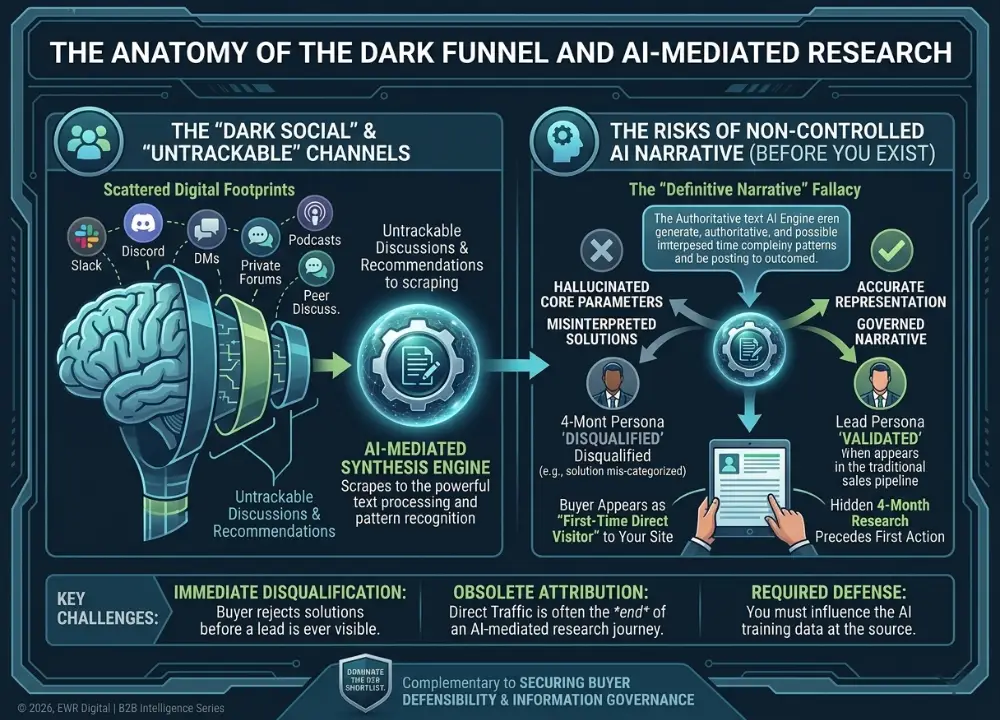
Dark social and the dark funnel refer to the interactions that happen across untrackable channels, including private Slack communities, direct messages, peer-to-peer discussions, and closed industry forums. In 2026, AI engines act as an aggregate consumer of these dark social channels, scraping public forums, community transcripts, and editorial platforms to build entity relationships. When buyers use generative tools to summarize market options, they are leveraging an engine that has already synthesized thousands of scattered digital footprints into a single definitive narrative.
This reality completely upends traditional multi-touch attribution models. A buyer might appear as a first-time direct visitor on your website analytics, but in truth, they have already spent four months assessing your company’s suitability via AI summaries. If the generative engine hallucinates your core service parameters or misinterprets your specialized solutions during those first 150 days, you are disqualified before you ever know the lead exists.
How Generative Search Engines and LLMs Process Brand Entities
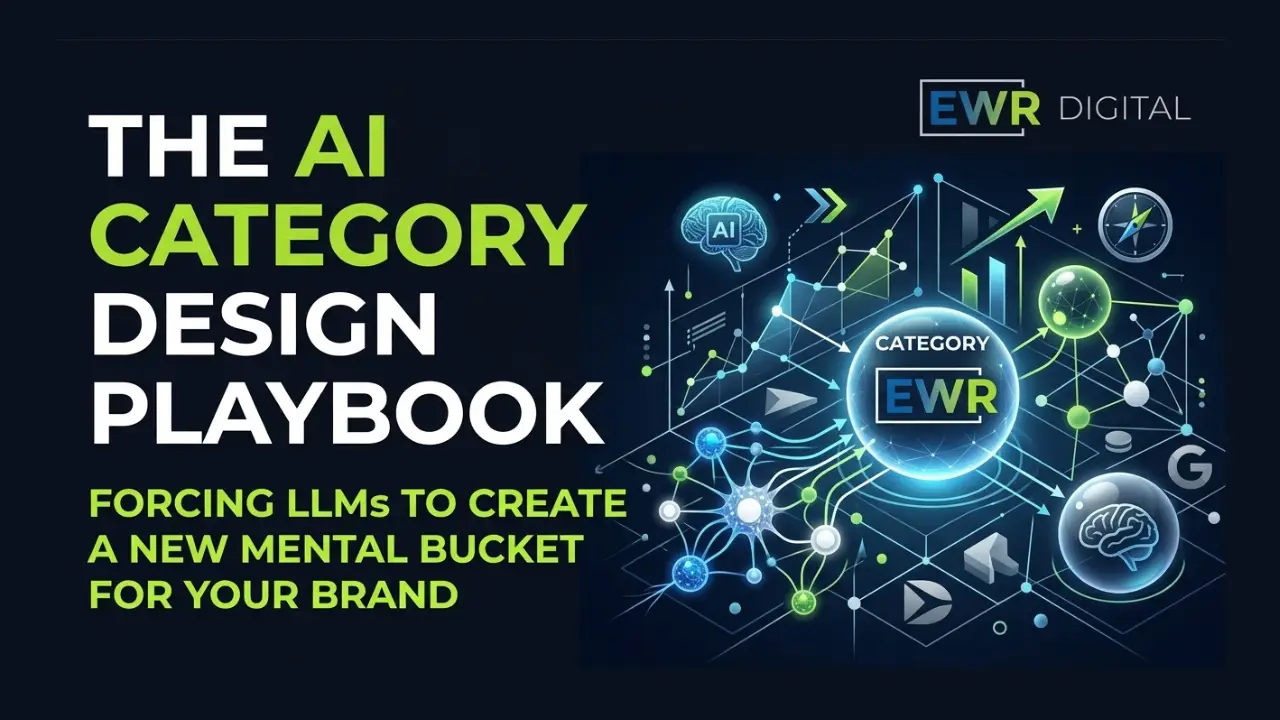
To win visibility during the covert research phase, you must understand how modern AI search engines interpret your digital presence. Traditional search engine optimization relied heavily on keyword frequency and backlink volume. In contrast, generative engines utilize entity-based indexing. AI models view your business as a central entity connected to various attributes, industries, and outcomes via data nodes. Insights
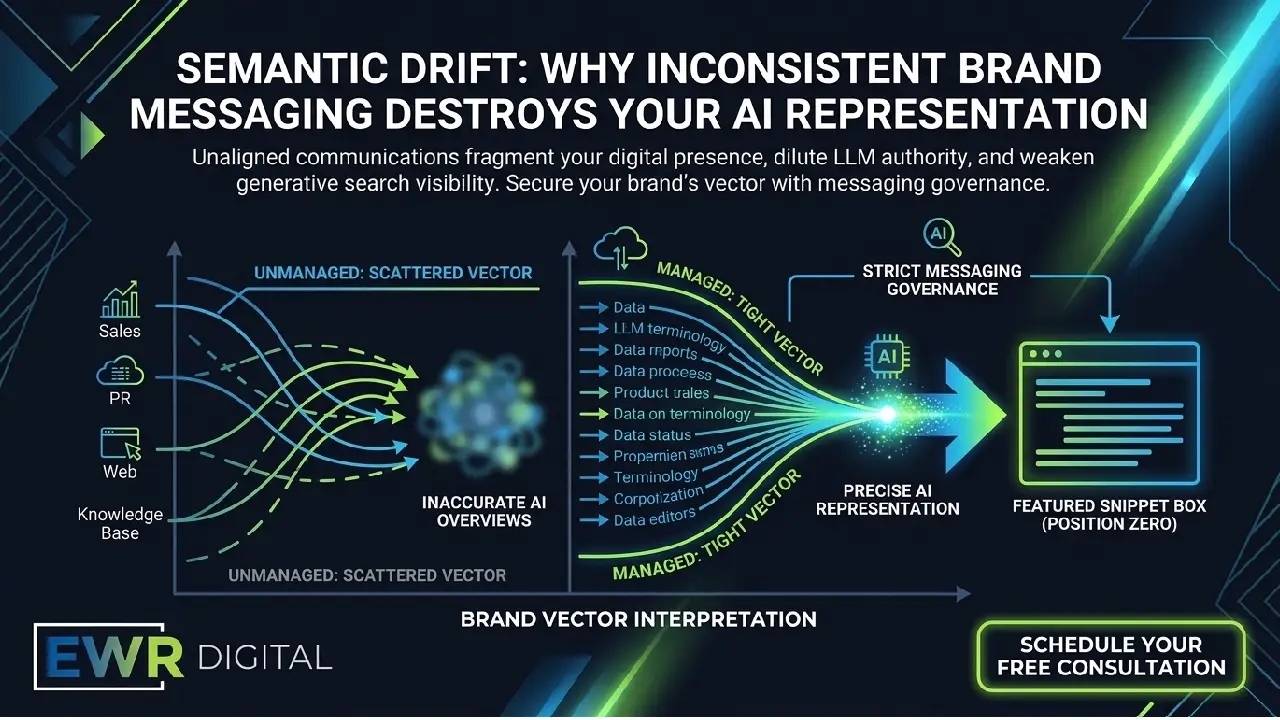
When an LLM attempts to answer a specific buyer query, it evaluates the strength of these entity connections. If your enterprise specializes in manufacturing growth systems but your website copy uses generic marketing agency terminology, the AI experiences a semantic mismatch. The algorithm will struggle to categorize your brand accurately, frequently defaulting to a generalist classification that dilutes your specialized authority and lowers your recommendation probability on shortlists.
Overcoming the Risk of Algorithmic Hallucination
AI models are fundamentally designed to generate helpful, coherent responses, but they are not inherently programmed to verify factual accuracy against your internal benchmarks. When an LLM encounters gaps or conflicting data signals within your public footprint, it attempts to resolve the ambiguity by predicting the most probable text response. This leads to AI hallucinations, where the model confidently presents inaccurate pricing structures, non-existent service limitations, or outdated corporate capabilities to prospective enterprise buyers.
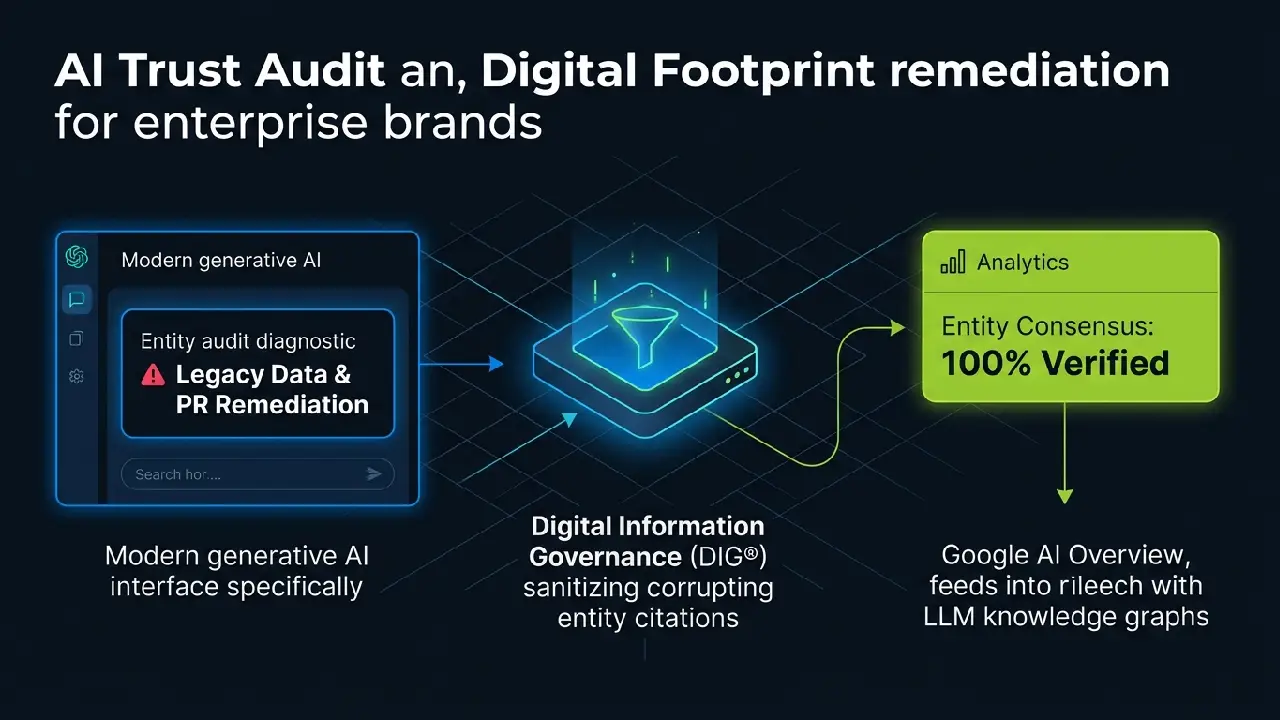
Eliminating these risks requires rigorous digital information governance. Organizations must ensure that every public-facing asset, from corporate documentation to PR distributions, presents a highly unified, non-contradictory semantic message. By explicitly dictating your brand relationships through machine-readable web architecture, you actively guide the algorithm’s conceptual mapping of your enterprise.
Generative AI search represents a profound shift from a directory of destinations to an engine of answers, requiring organizations to fundamentally rethink how their data is structured and presented to the web.Gartner Research Insights
The Strategy: Injecting “Expert Takes” and “Human Stories” into the Latent Space
Winning the first 150 days of the invisible B2B buyer journey requires a deliberate pivot toward content styles that AI engines prioritize for authority validation. You cannot out-publish the web with generic, automated content. Instead, your digital infrastructure must feed the models highly unique, non-commodity data points that prove real-world expertise and cultural relevance.
According to comprehensive performance data analyzed across LinkedIn and B2B media landscapes, creative quality and authoritative positioning dictate analytical performance\. By deploying targeted, human-centric content pillars, you construct an immutable data trail that generative search engines crawl to verify your organization’s domain mastery.
| Content Mechanism | Engagement Impact | AI Indexing Purpose |
|---|---|---|
| Expert Takes (Executive Insights) | +53% Engagement | Establishes authoritative semantic authorship nodes. |
| Human Stories (People-Led Narrative) | +65% Engagement | Creates highly unique, non-commodity data variants. |
| Cultural Coding (Pop-Culture & Memes) | +41% to +111% Engagement | Increases modern relational context within LLM models. |
Leveraging Executive Insights for Machine-Readable Authority
Featuring your internal executive experts on public stages and digital channels does more than just appeal to human buyers; it provides the primary verifiable data points that AI engines use to build their trust indexes. When an industry executive publishes an original breakdown of an operational challenge on a platform like LinkedIn, they are generating a highly authoritative text node. AI models monitor these expert takes to connect the executive’s named entity directly to the corporate brand entity, reinforcing your organization’s specialized niche.
To maximize this effect, executive content should be structured cleanly with explicit entity declarations. Avoid vague prose. Instead, use clear industry terminology, reference specific operational frameworks, and anchor the commentary around your primary business offerings. This structured approach makes it seamless for LLM web crawlers to categorize the insights as decision-grade source material.
The Power of Non-Commodity, People-Led Narratives
Because generative AI models are trained on mass-market data, they excel at replicating generic industry advice. This makes standard, boilerplate blog articles entirely obsolete. To stand out to both human purchasing groups and artificial intelligence algorithms, your content must emphasize real-world human stories and detailed case studies.
People-led stories introduce highly distinct, original data patterns that cannot be simulated by an algorithm. When you document a specific customer journey, detail exact operational friction points, and explain the precise human mechanics required to deploy a solution, you provide an exclusive dataset. When AI engines crawl these narratives, they extract authentic brand proof points that improve your recommendation frequency when buyers ask models for real-world case examples.
Securing Buyer Defensibility to Dominate the Shortlist
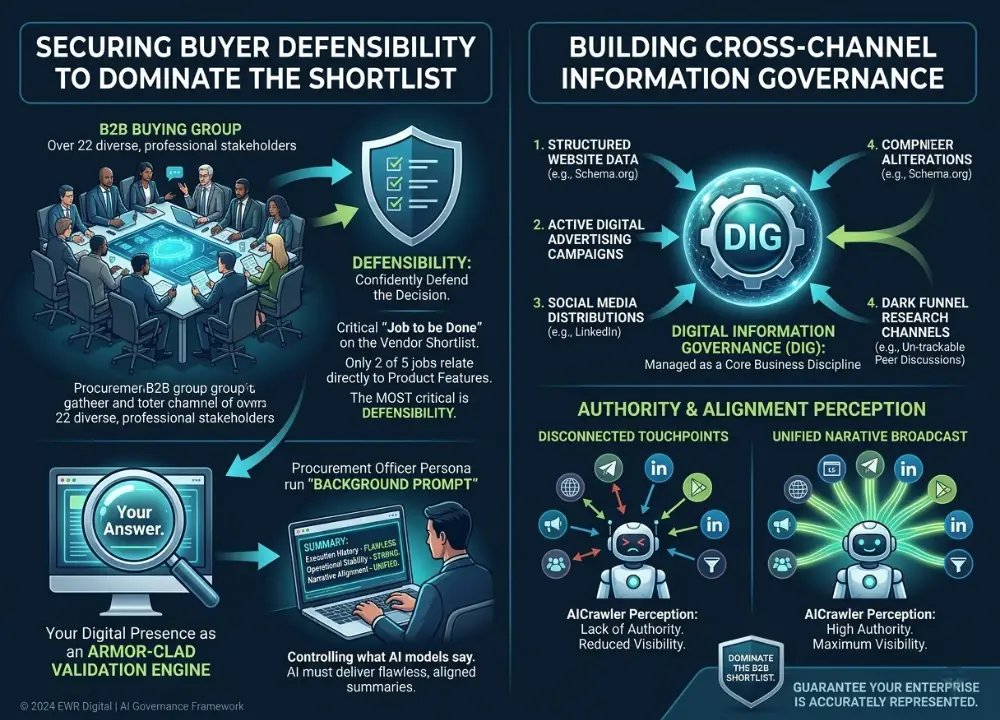
As a vendor selection process progresses, a B2B buying group has multiple internal jobs to execute. While technical product evaluations are standard, data shows that on a vendor shortlist, a buyer has five distinct jobs to be done, and only two are directly related to the product features themselves. The single most critical job to be done for an internal buyer is defensibility: the absolute necessity to feel confident that they can defend their final vendor decision to a massive group of 22+ corporate stakeholders.
In a machine-first research landscape, providing this defensibility means controlling what AI models say about your business. If a corporate procurement officer runs a background prompt on your firm to verify your operational stability, the AI must deliver a flawless, highly aligned summary of your execution history. Your digital presence must serve as an armor-clad validation engine that gives every stakeholder absolute confidence that choosing your enterprise is the safest, most logical path forward.
Building Cross-Channel Information Governance
Maintaining absolute alignment across your entire digital footprint requires unifying your multi-channel touchpoints. Your structured website data, your active digital advertising campaigns, and your social media distributions must all broadcast a harmonized narrative. For example, if your multi-channel touchpoints are disconnected, an AI crawler will perceive a lack of authority, reducing your overall visibility score in search environments.
To implement this governance effectively, companies must move beyond treating search optimization as an isolated marketing tactic. It must be managed as a core business discipline: Digital Information Governance. By systematically monitoring how AI models synthesize your corporate assets, you protect your market reputation from automated distortion and guarantee that your enterprise is accurately represented across every dark funnel research channel.
Take Control of Your Generative Footprint
The modern 211-day B2B buyer journey leaves no room for weak digital signals or machine speculation. If you leave your corporate reputation up to the predictive text algorithms of unguided LLMs, you risk losing high-value enterprise accounts before your sales team ever has the opportunity to present a proposal. You must actively feed generative engines the exact structured data, expert insights, and human stories needed to validate your marketplace authority. Stop guessing what occurs within the invisible dark funnel. Master your AI search visibility, secure buyer defensibility, and audit your digital information governance by partnering with EWR Digital today.
Industry Insight Stat: According to data verified by Gartner, by the conclusion of 2026, traditional search engine volume is projected to drop by 25% across the global digital landscape, driven entirely by the rapid migration of enterprise consumers toward AI chatbots and generative virtual agents. Source: Gartner Press Resource

Matthew (Matt) Bertram helps energy and industrial companies get found, trusted, and chosen as AI reshapes how buyers decide. As owner and CEO of EWR Digital, he leads the agency's AI search and SEO work for oil and gas and other capital-intensive industries; he is also President of ModalPoint. He is also Chief Marketing Officer of the Oil & Gas Global Network (OGGN) and the author of multiple books, including LLM Visibility: A Decision-Grade System for Winning AI-Mediated Discovery and the co-authored Oil & Gas Sales & Marketing: The Energy Growth Playbook for Oil and Gas Leaders. He is a member of the American Petroleum Institute's Houston Chapter and the International Association of Privacy Professionals (IAPP).