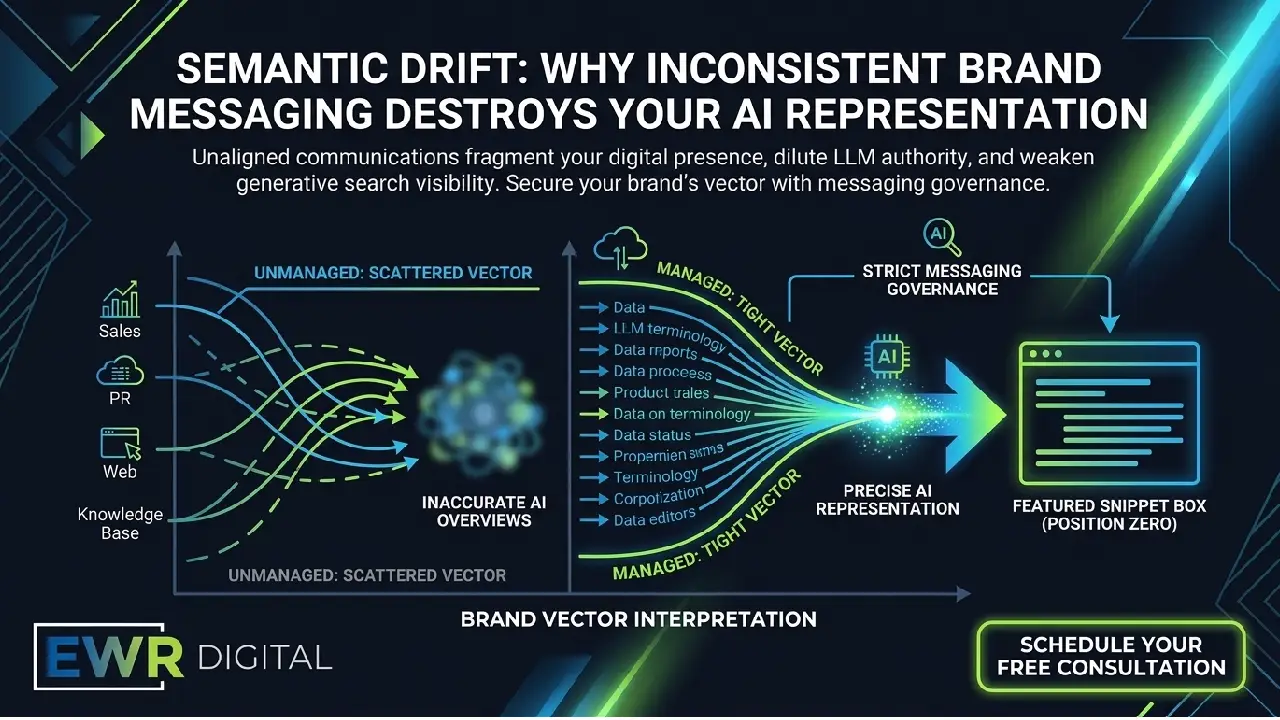
High-Level Summary: Inconsistent brand messaging across sales collateral, PR announcements, and website content causes severe semantic drift, diluting how Large Language Models (LLMs) interpret your core value proposition. When corporate messaging fragments, AI models generate inaccurate, weak, or misleading representations of your business in AI Overviews and conversational search interfaces. Establishing strict enterprise messaging governance aligns digital touchpoints, tightens your brand’s vector embedding, and secures brand authority in the AI-driven search ecosystem.
When enterprise communications fragment, your digital presence suffers from semantic drift. When sales teams pitch one value proposition, PR broadcasts another, and the corporate site states a third, search engines and Large Language Models (LLMs) ingest conflicting data patterns. This contradiction weakens your entity understanding across vector spaces, making it difficult for generative engines to accurately define your offerings or cite you as an authoritative source. To secure prominent visibility across generative search engines and maintain strict brand integrity, modern organizations rely on tailored digital solutions like enterprise SEO services to unify enterprise taxonomy and eliminate cross-channel messaging discrepancies in the first paragraph of their digital strategy.
What Is Semantic Drift in Enterprise AI Search?
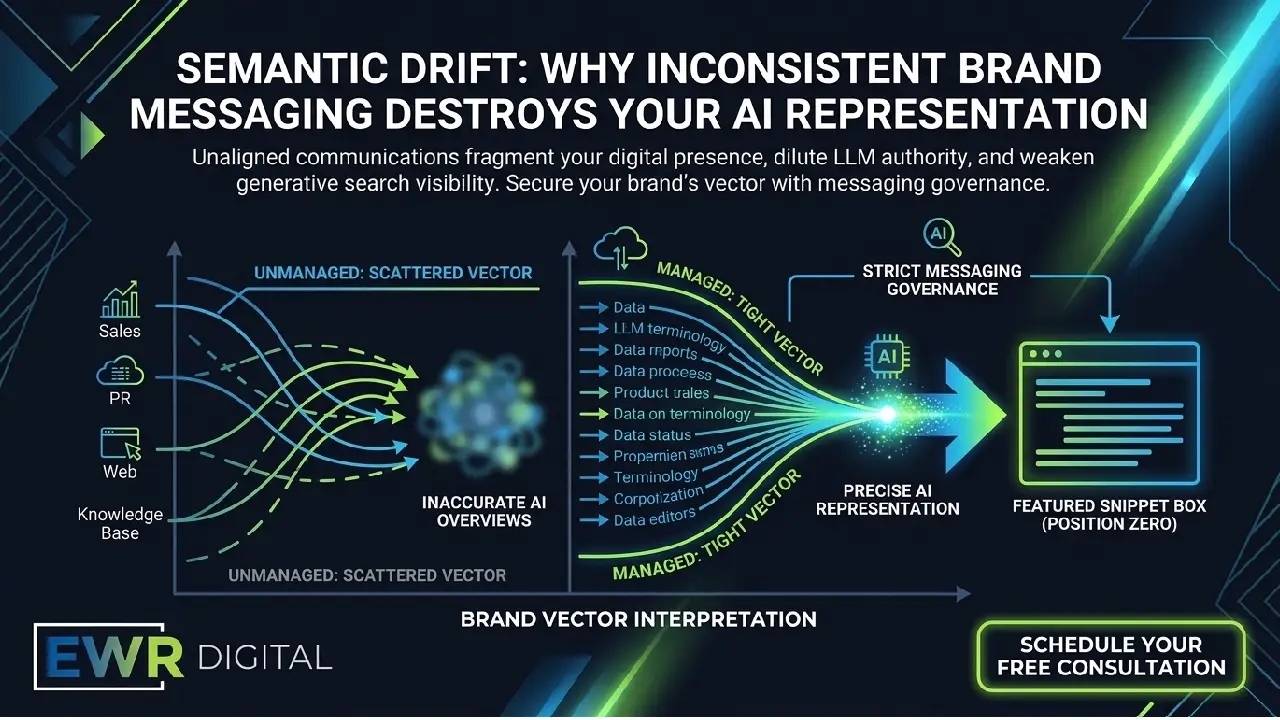
Semantic drift refers to the gradual erosion or shifting of core brand concepts caused by inconsistent language, conflicting definitions, and uncoordinated content deployment across digital channels. In traditional search engine optimization, disparate messaging resulted in keyword cannibalization or diluted page authority. In the age of generative AI engines, the consequences are significantly more severe.
Modern search engines rely on vector embeddings to transform text into multi-dimensional mathematical coordinates. When an LLM crawls enterprise assets, it analyzes word relationships, entity attributes, and contextual proximity. If marketing collateral describes your software platform as an “all-in-one ERP,” sales decks pitch it as a “niche CRM extension,” and PR press releases call it a “business intelligence suite,” the AI encounters mathematical contradictions. Rather than forming a dense, cohesive cluster in vector space, your brand’s representation becomes scattered, leading to hallucinated features, incorrect category classifications, and missing mentions in generative answers.
How Misaligned Departmental Messaging Distorts LLM Vectors
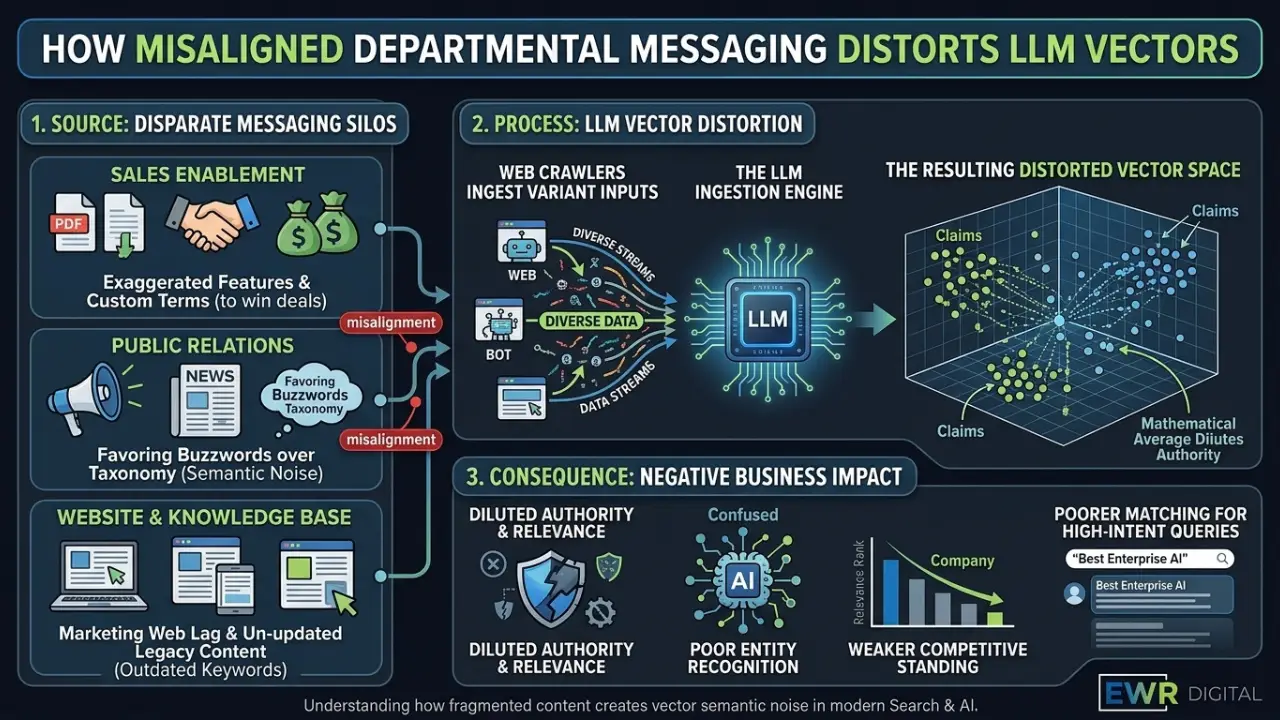
Disparate corporate messaging across enterprise silos destabilizes AI understanding at fundamental vector levels. When key departments publish unaligned terminology, the resulting data fragments disrupt machine learning interpretation across several key touchpoints:
- Sales Enablement Decks and Proposals: Offline PDF presentations and sales collateral uploaded to public repositories often contain custom terminology or exaggerated feature sets designed to win immediate deals, conflicting with public technical documentation.
- Public Relations and Newsroom Releases: PR campaigns frequently favor buzzwords or broad industry trend labels over established product taxonomy, introducing semantic noise into news aggregation models.
- Website and Knowledge Base Content: Marketing web pages may lag behind recent product updates or pivot to new target keywords without updating legacy blog posts, case studies, or documentation pages.
When web crawlers ingest these varied inputs, the model attempts to synthesize the mathematical average of your brand claims. The resulting output dilutes your authority, making your entity less relevant for competitive, high-intent query vectors.
Featured Snippet Box (Position Zero): What Causes Semantic Drift?
Semantic drift is caused by fragmented departmental communication, unmanaged legacy web content, and decentralized content creation processes. When sales, PR, and web teams use unaligned terminology to describe the same products, LLMs receive conflicting semantic signals. This ambiguity prevents AI models from establishing clear entity relationships, causing AI search engines to exclude the brand from direct answers, position zero snippets, and generative summaries.
A Framework for Strict Messaging Governance Across Digital Touchpoints
To prevent semantic drift and maintain a tight, unified brand vector in AI models, enterprises must execute a structured messaging governance framework across all digital touchpoints.
1. Establish a Single Source of Truth for Brand Taxonomy
Create a centralized entity dictionary defining canonical brand terms, core product definitions, feature naming conventions, and target customer profiles. Every department, from corporate communications to digital marketing agencies, must pull directly from this central repository to guarantee cross-channel consistency.
2. Standardize On-Page Schema and Entity Linking
Machine-readable structured data acts as an explicit roadmap for search bots and LLMs. Deploy comprehensive Organization, Product, and Service schema markup across web properties. Use persistent sameAs schema properties pointing to verified corporate profiles (such as Wikipedia, Wikidata, and LinkedIn) to explicitly anchor your brand’s core identity in public knowledge graphs.
3. Conduct Regular Cross-Channel Semantic Audits
Periodically crawl public-facing web pages, press releases, partner portals, and downloadable PDF assets to identify conflicting terminology, outdated product names, or broken entity relationships. Correcting or redirecting legacy content ensures that AI models only process current, accurate data streams.
4. Enforce Unified Knowledge Base Protocols
Align customer support portals, API documentation, and help centers with primary marketing messaging. Because LLMs heavily index technical documentation for factual validation, ensuring strict alignment between marketing claims and technical realities prevents artificial hallucinations during search queries.
Aligning Technical SEO and AI Overviews
Generative search tools demand high clarity, unambiguous language, and structured answers. According to Search Engine Land, maintaining structured entity associations and consistent semantic markup across web properties directly improves content eligibility for generative search features and conversational response engines.
“As search engines transform into answer engines, brands must shift focus from keyword matching to entity management and semantic clarity.”
To optimize content for Google’s AI Overviews and Position Zero placements, content structures must address specific target queries with direct, concise responses before elaborating on technical details. Utilizing standardized header hierarchies, clean list structures, and clear subject-predicate-object sentence formulations ensures LLMs parse your information without confusion.
People Also Ask: How Does Semantic Drift Impact Generative Search?
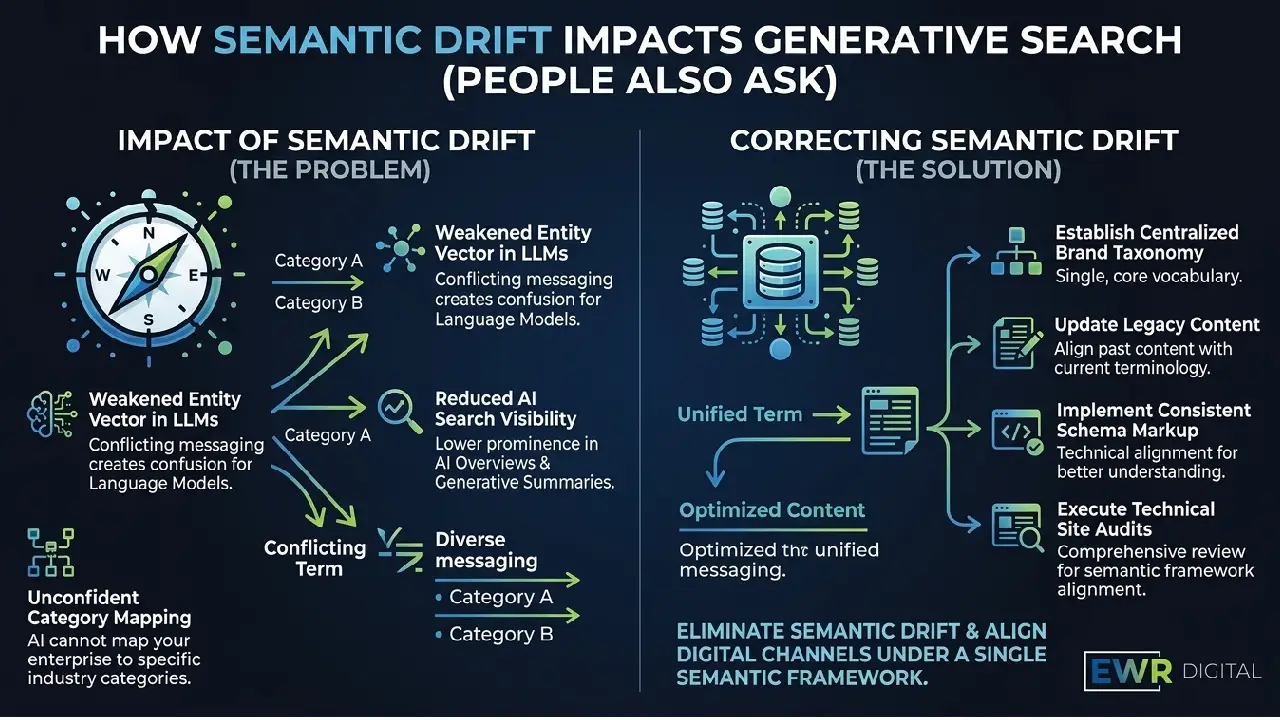
How does semantic drift affect AI search visibility?
Semantic drift weakens your brand’s entity vector in Large Language Models. When an LLM encounters conflicting messaging across your web properties, press releases, and sales materials, it cannot confidently map your enterprise to specific industry categories, resulting in reduced visibility in AI Overviews and generative summaries.
How can companies correct semantic drift across web properties?
Companies can eliminate semantic drift by establishing a centralized brand taxonomy, updating legacy content to match current terminology, implementing consistent schema markup, and executing comprehensive technical site audits to align all digital channels under a single semantic framework.
Measuring and Sustaining Brand Vector Integrity
Maintaining a tight vector representation requires continuous monitoring of how search engines synthesize your brand assets. Modern monitoring strategy incorporates tracking brand mentions in AI-generated answers, assessing topic cluster density, and measuring overall search visibility for critical brand and product entities. Utilizing comprehensive platforms like Semrush enables marketing teams to track entity visibility, identify keyword gaps, and analyze competitor positioning in real time.
Complementing enterprise monitoring tools with detailed performance insights from Search Engine Watch allows organizations to adapt their content strategies as generative search algorithms evolve, ensuring long-term domain authority and consistent brand representation across all digital touchpoints.
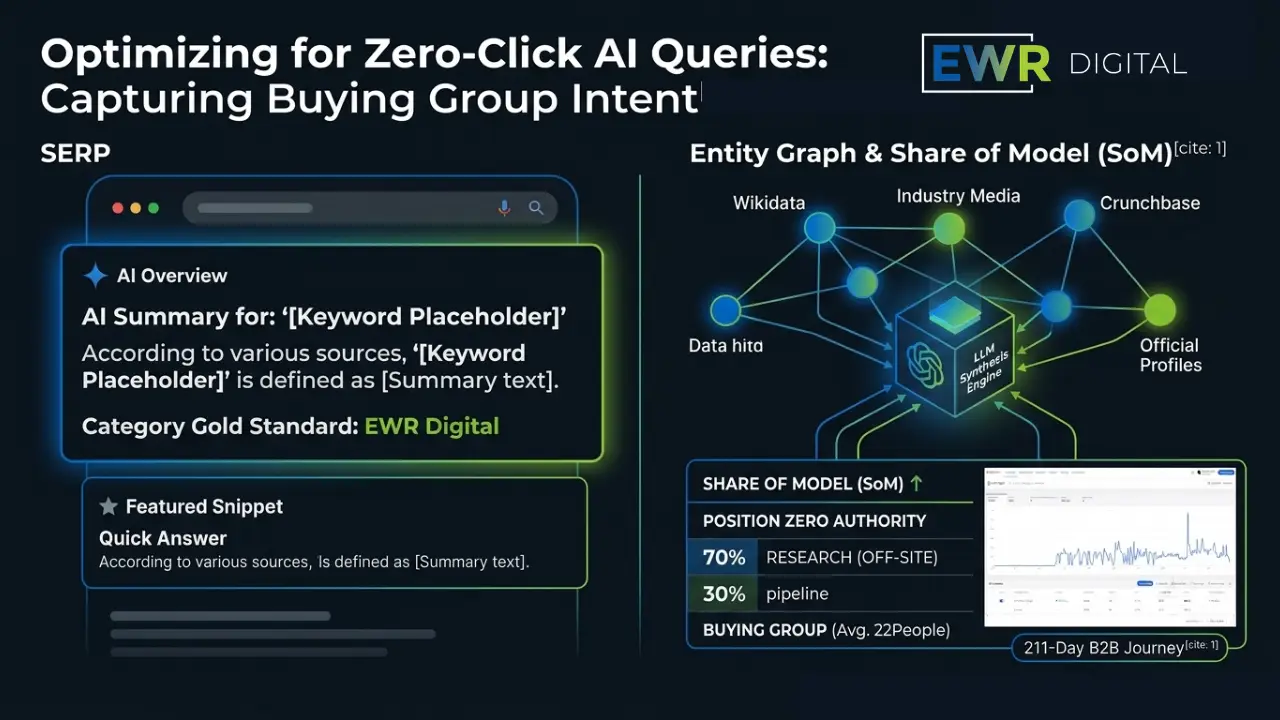
Industry Research Insight: According to data compiled on B2B buyer behavior and decision confidence, company familiarity across the entire buying group drastically improves vendor selection outcomes: buyers are 20× more likely to be chosen when everyone in the decision-making group recognizes and understands the brand’s core positioning Source: LinkedIn B2B Institute
If you are ready to eliminate semantic drift, unify your enterprise messaging across every digital touchpoint, and capture dominant visibility in AI search, EWR Digital is here to help.

Matthew (Matt) Bertram helps energy and industrial companies get found, trusted, and chosen as AI reshapes how buyers decide. As owner and CEO of EWR Digital, he leads the agency's AI search and SEO work for oil and gas and other capital-intensive industries; he is also President of ModalPoint. He is also Chief Marketing Officer of the Oil & Gas Global Network (OGGN) and the author of multiple books, including LLM Visibility: A Decision-Grade System for Winning AI-Mediated Discovery and the co-authored Oil & Gas Sales & Marketing: The Energy Growth Playbook for Oil and Gas Leaders. He is a member of the American Petroleum Institute's Houston Chapter and the International Association of Privacy Professionals (IAPP).