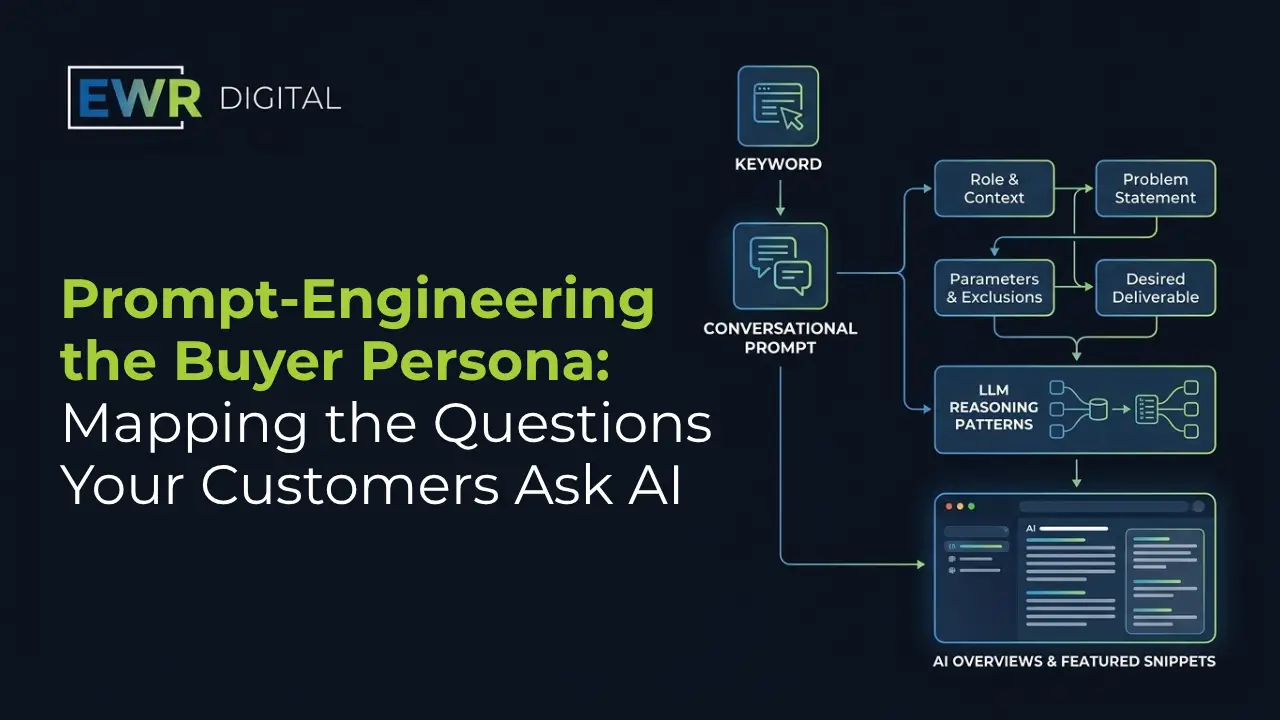
High-Level Summary: Modern executives no longer query search engines with short fragments; they interact with AI assistants using complex, multi-step prompts. This guide demonstrates how to transition from traditional keyword research to prompt research, enabling B2B marketers to reverse-engineer conversational queries and map buyer personas directly to LLM reasoning patterns.
Traditional SEO relies heavily on short-tail keyword phrases, but modern executives interact with generative assistants using rich, contextual queries. Learning how to conduct effective
prompt research
allows marketing teams to map real conversational workflows, pain points, and evaluation criteria directly into their content strategy. By understanding how business leaders query artificial intelligence to solve complex challenges, brands can align their content with the multi-step reasoning patterns of modern LLMs. Partnering with a specialized
digital marketing agency
enables organizations to build structured content hubs that systematically capture AI-driven referral traffic.
From Keywords to Prompts: The Evolution of Customer Intent Discovery
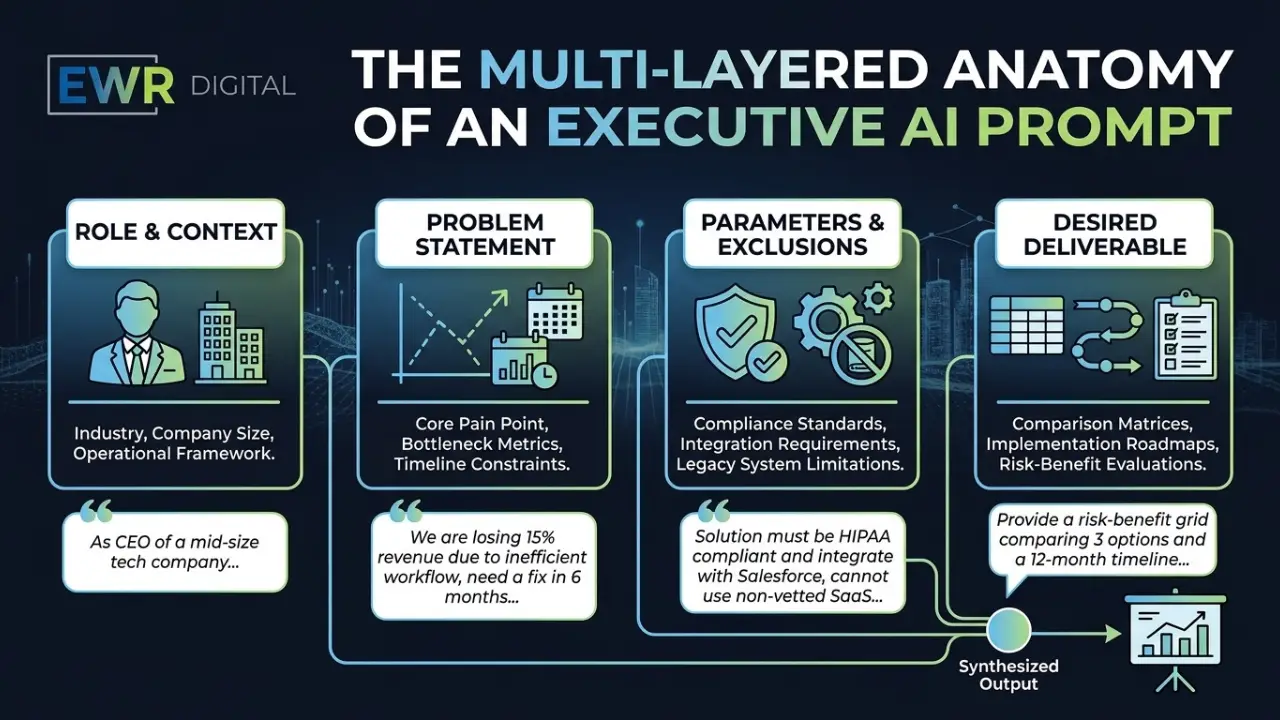
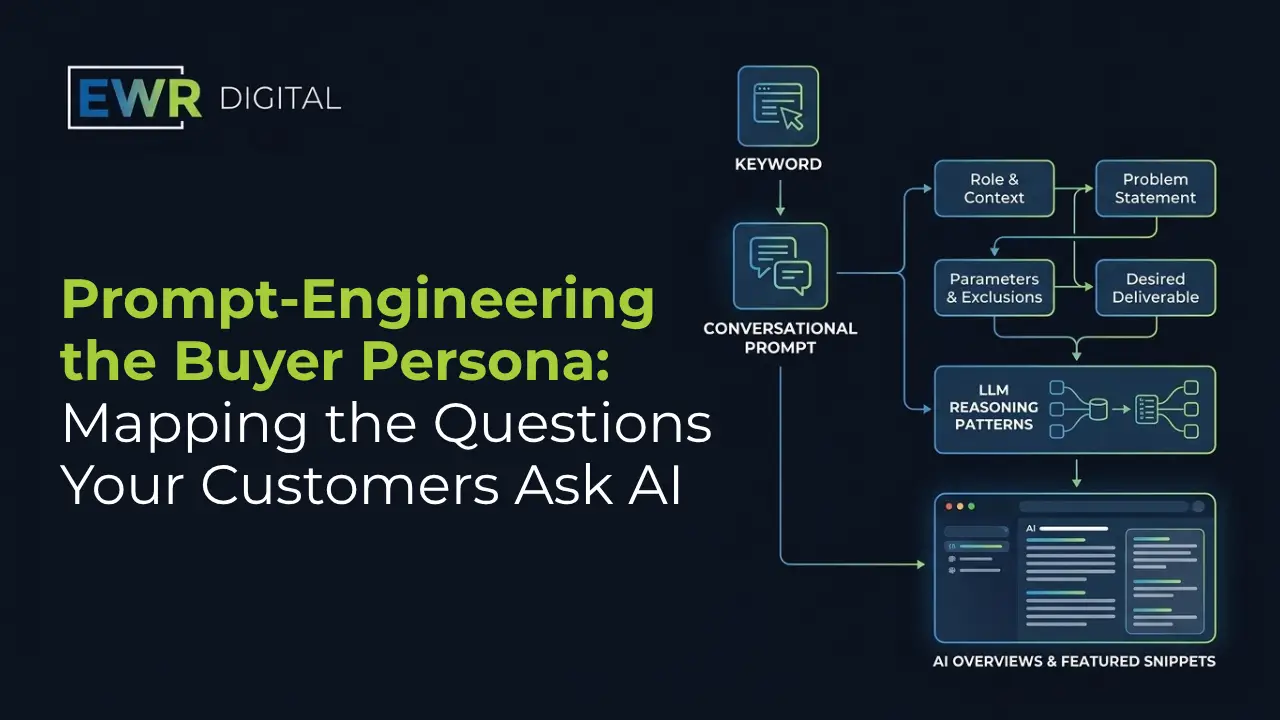
Traditional search behavior focused on concise queries like “best enterprise CRM software.” In contrast, executive prompt behavior is conversational, highly detailed, and multi-layered. An executive asking an AI assistant for a solution rarely inputs a two-word phrase; instead, they provide context, operational constraints, budget ranges, and specific requirements in a single prompt.
Prompt research involves identifying the underlying structure of these long-form queries. Rather than tracking individual keyword volume, marketers must map the key components that buyers include when asking AI to evaluate vendors or solve operational bottlenecks:
- Role & Context: “As a VP of Marketing at a mid-market B2B SaaS company…”
- Operational Constraint: “…facing a 20% reduction in customer acquisition budget…”
- Specific Goal: “…recommend three strategies to improve organic conversion rates within six months.”
- Output Format: “…and format the output as a comparative risk-reward matrix.”
Step-by-Step Guide to Conducting Effective Prompt Research
To execute prompt research effectively, marketing teams must move beyond keyword databases and build a structured methodology for discovering conversational query patterns.
1. Analyze Internal Customer Interaction Data
Start by auditing sales calls, customer support tickets, and discovery questionnaires. Look for multi-sentence questions that buyers ask during sales conversations. Transform these real-world discussions into prompt templates that mirror how executives structure their questions when speaking to AI assistants.
2. Map the Decision-Maker’s Reasoning Chain
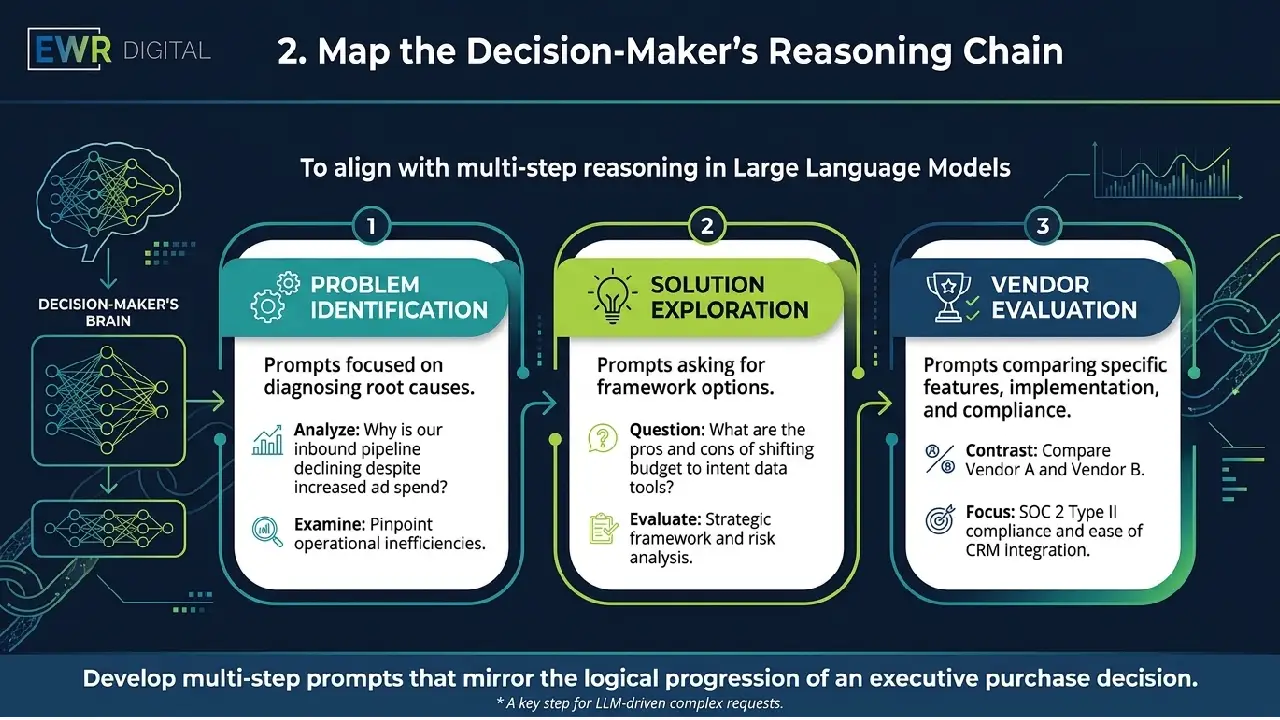
Large language models process complex requests through multi-step reasoning. To align with this behavior, map out the logical progression an executive follows during a purchase decision:
- Problem Identification: Prompts focused on diagnosing root causes (e.g., “Why is our inbound pipeline declining despite increased ad spend?”).
- Solution Exploration: Prompts asking for framework options (e.g., “What are the pros and cons of shifting budget to intent data tools?”).
- Vendor Evaluation: Prompts comparing specific features, implementation timelines, and security compliance (e.g., “Compare Vendor A and Vendor B for SOC 2 Type II compliance and ease of CRM integration.”).
3. Use AI to Simulate Executive Prompt Variations
Leverage AI tools to reverse-engineer potential prompts. By feeding your target buyer persona’s goals, key performance indicators (KPIs), and operational pain points into an LLM, you can prompt the model to generate the exact questions an executive in that role would ask when seeking advice.
“Prompt engineering is the process of structuring text that can be interpreted and understood by a generative AI model.” TechTarget Enterprise AI Insights
Structuring Content for Multi-Step LLM Reasoning Patterns
Once you have mapped your target audience’s prompt structures, you must organize your content so that LLM crawlers can easily ingest, synthesize, and cite your insights.
| Traditional SEO Focus | Prompt-Centric Content Focus | LLM Ingestion Benefit |
|---|---|---|
| Single keyword density | Contextual problem-and-solution clusters | Provides full context for complex generative answers. |
| Static product feature pages | Comparative matrices and constraint-based guides | Allows models to extract factual data for vendor comparisons. |
| Short-tail FAQ lists | Scenario-driven decision frameworks | Matches multi-step reasoning structures during synthesis. |
Frequently Asked Questions About Prompt Research
How does prompt research differ from traditional keyword research?
Keyword research focuses on individual search terms and search volume metrics on traditional search engines. Prompt research analyzes conversational, multi-sentence queries, focusing on context, buyer constraints, and multi-step evaluation patterns used when interacting with AI assistants.
Which channels provide the best data for prompt research?
The best data sources include recorded sales calls, customer success notes, industry forums, executive Q&A sessions, and direct prompt simulations using generative AI tools trained on buyer persona profiles.
How can marketers ensure their content is cited in AI-generated answers?
Publish clear, structured, and factual content that directly answers complex, scenario-based questions. Utilizing comparative tables, bulleted lists, and explicit entity relationships helps LLMs recognize your content as an authoritative source during retrieval-augmented generation (RAG) processes.
Transforming Prompt Insights into Competitive Advantage
By shifting from basic keyword targets to comprehensive prompt research, modern marketers can create content that precisely mirrors executive decision-making processes. Understanding the detailed questions your ideal buyers ask AI ensures that your brand remains visible, relevant, and recommended across every stage of the modern buying journey.
According to B2B purchasing research, the average buying group in B2B transactions consists of 22 people, making multi-stakeholder decision defense a top priority for decision-makers. Source: LinkedIn B2B Institute Data.
If you want to stay ahead of changing search behaviors and optimize your brand for AI-driven discovery, schedule a free consultation with EWR Digital today to elevate your digital marketing strategy.

Matthew (Matt) Bertram helps energy and industrial companies get found, trusted, and chosen as AI reshapes how buyers decide. As owner and CEO of EWR Digital, he leads the agency's AI search and SEO work for oil and gas and other capital-intensive industries; he is also President of ModalPoint. He is also Chief Marketing Officer of the Oil & Gas Global Network (OGGN) and the author of multiple books, including LLM Visibility: A Decision-Grade System for Winning AI-Mediated Discovery and the co-authored Oil & Gas Sales & Marketing: The Energy Growth Playbook for Oil and Gas Leaders. He is a member of the American Petroleum Institute's Houston Chapter and the International Association of Privacy Professionals (IAPP).