

Control How Search Engines and AI Interpret Your Organization
SEO is no longer a marketing channel.
It is a governance risk surface.
Search engines and AI systems now decide how your organization is represented, summarized, and trusted, often without human review. When those systems encounter conflicting or fragmented data, they do not wait for clarification. They infer.
Inference is not accuracy.
EWR Digital provides enterprise SEO services that help search engines and AI systems consistently interpret, represent, and trust your organization across all digital environments.
The Problem: Visibility Without Governance Is a Liability
Most enterprises still treat SEO as a demand channel owned by marketing.
That model is no longer sufficient.
Modern search and AI systems:
-
Resolve entities, not pages
-
Synthesize facts, not links
-
Prioritize consensus, not optimization tactics
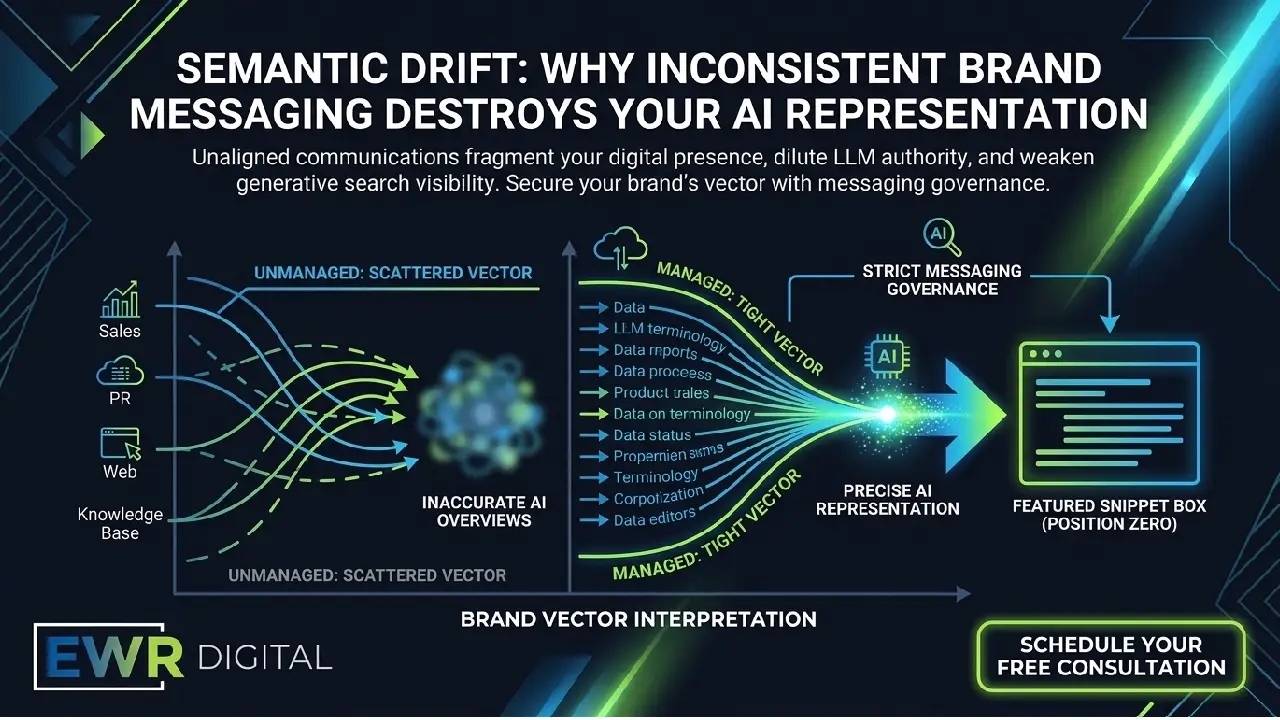
When your organization lacks enforced consistency across machine-readable environments, AI systems create their own version of your brand.
That creates:
-
Reputational risk
-
Confused buyer journeys
-
Slower diligence and procurement cycles
-
Loss of narrative control at scale
If SEO is fragmented, machines interpret that fragmentation as uncertainty.

Why This Is an Enterprise Issue (Not a Marketing Task)
SEO governance now touches areas far beyond marketing execution:
-
Corporate entity data
-
Executive and leadership attribution
-
Brand authority references
-
Third-party data aggregators
-
Knowledge graphs and AI training sources
Marketing teams cannot enforce:
-
Legal entity consistency
-
External data correction
-
Authority anchoring across independent systems
This creates responsibility without authority, and risk without ownership.
Enterprise SEO governance requires executive sponsorship, cross-functional alignment, and formal control mechanisms.
Our Solution: Enterprise SEO and AI Search Visibility
EWR Digital helps enterprises shape how machines interpret their organization across search engines, AI systems, and third-party data ecosystems.
This is not traditional SEO.
This is an organizational control infrastructure.
What Our Enterprise SEO Services Include
1. Entity Unification & Canonical Control
We establish and enforce a single, authoritative identity for your organization across all machine-readable environments.
-
Corporate entity alignment
-
Brand, sub-brand, and leadership consolidation
-
Resolution of conflicting representations
2. External Data Source Alignment
AI systems rely heavily on third-party data sources. We identify, audit, and correct them.
-
Data aggregator correction
-
Knowledge graph consistency
-
High-risk source mitigation
3. Authority Anchoring
We secure high-trust, editorially governed references that stabilize machine consensus.
-
Trusted reference placement
-
Consensus reinforcement
-
Long-term authority compounding
4. Defensive Signal Control
We identify and mitigate risks that distort machine interpretation.
-
Spoofing and impersonation prevention
-
Negative SEO risk mitigation
-
Conflicting signal suppression
5. AI Interpretation Alignment
We ensure large language models converge on a consistent, accurate narrative about your organization.
-
AI-generated summary audits
-
Narrative correction strategies
-
Ongoing monitoring and alignment
“As organizations adopt AI, the consistency and governance of digital information become central to trust and decision making.”
Outcomes Enterprises See
Organizations that implement SEO governance experience:
-
Consistent AI-generated brand summaries
-
Faster buyer and diligence cycles
-
Reduced reputational and data integrity risk
-
Stronger executive and leadership visibility
-
Increased trust during acquisition, expansion, or market pressure
Instead of reacting to algorithm changes, leadership teams proactively shape how machines interpret their company.
When You Need SEO Governance
This service is designed for organizations that:
-
Operate across multiple brands, locations, or business units
-
Are you prepared for growth, acquisition, or market expansion?
-
Are you experiencing inconsistent or inaccurate AI summaries?
-
Require a defensible, authoritative digital representation
-
Cannot afford reputational ambiguity at scale
If any of these apply, SEO governance is no longer optional.
Start With an Enterprise SEO Visibility Assessment
Most enterprises do not know how fragmented their external representation has become.
The first step is visibility.
Request an Enterprise SEO Visibility Assessment to identify:
-
Conflicting entity signals
-
High-risk external data sources
-
AI interpretation inconsistencies
-
Governance gaps across systems
Why EWR Digital
EWR Digital specializes in enterprise-level SEO and AI search visibility, not campaign-driven optimization.
Our engagements operate alongside:
-
Executive leadership
-
Legal and compliance teams
-
IT and data stakeholders
We focus on control, consistency, and authority, not traffic vanity metrics.
Take Control of How Machines Interpret Your Organization
SEO did not stop being valuable.
It stopped being optional.
In an AI-first world, visibility without governance is liability.
👉 Start taking control of how machines interpret your organization. Schedule a call with EWR Digital today.
Industry Insight: According to McKinsey, organizations that govern digital information at the enterprise level outperform peers in decision accuracy, trust, and operational speed as AI adoption accelerates.

Matthew (Matt) Bertram helps energy and industrial companies get found, trusted, and chosen as AI reshapes how buyers decide. As owner and CEO of EWR Digital, he leads the agency's AI search and SEO work for oil and gas and other capital-intensive industries; he is also President of ModalPoint. He is also Chief Marketing Officer of the Oil & Gas Global Network (OGGN) and the author of multiple books, including LLM Visibility: A Decision-Grade System for Winning AI-Mediated Discovery and the co-authored Oil & Gas Sales & Marketing: The Energy Growth Playbook for Oil and Gas Leaders. He is a member of the American Petroleum Institute's Houston Chapter and the International Association of Privacy Professionals (IAPP).