
Enterprise marketing teams across the globe are running into a frustrating wall when deploying generative intelligence tools. You type in a detailed instruction, specify a target audience, and wait for an asset that matches your standards, only to receive generic, surface-level copy that sounds like a template. Your AI isn’t stupid; it’s just starving for good data. The problem does not lie with your marketing team or the software you use; it stems from an incomplete informational pipeline. Relying on basic text inputs to teach an algorithm your complete corporate identity is an inefficient strategy. To unlock real performance, organizations must move beyond manual prompting and integrate a formalized enterprise SEO strategy that structures corporate identity directly at the data layer, ensuring all internal systems and external crawlers pull from a single verified source of truth.
The Structural Limitation of Generic Prompt Engineering
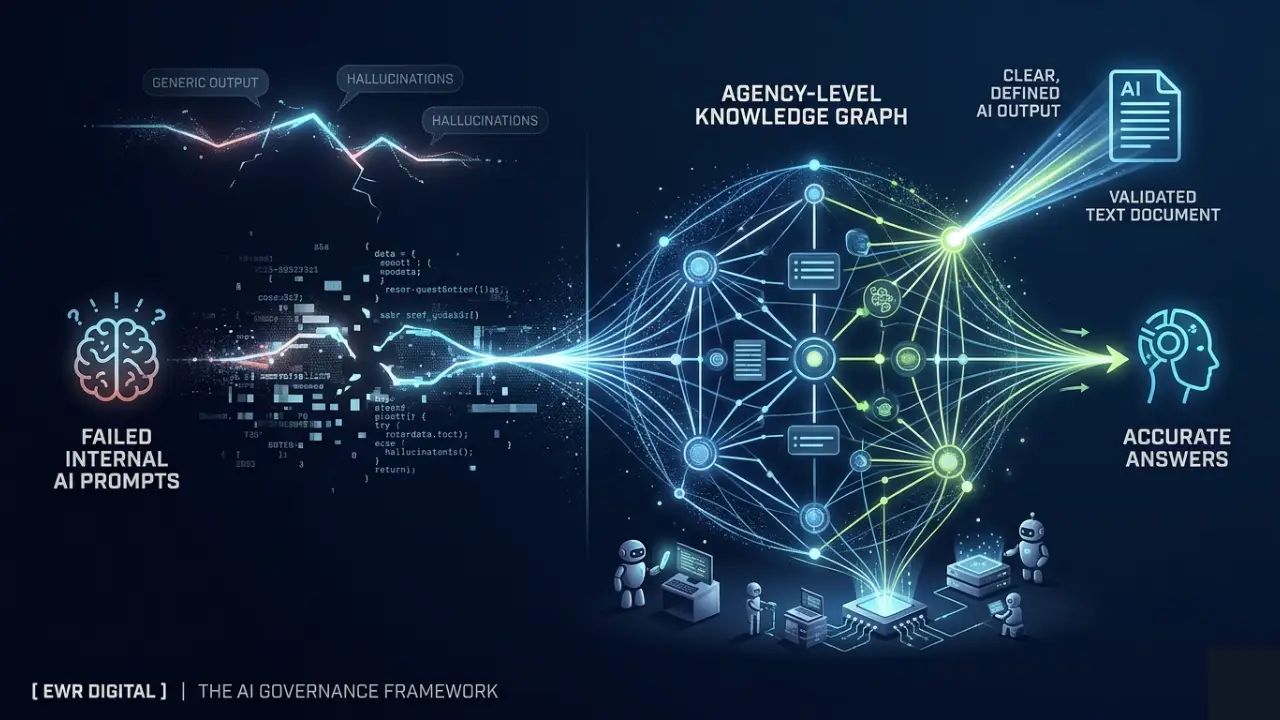
Most organizations attempt to fix poor machine output by investing heavily in long, complex system instructions. Teams build extensive template libraries that define tone, establish target personas, and list forbidden words. While this approach provides minor, temporary improvements, it fails to solve the underlying problem. Large language models operate as statistical prediction engines; they do not actually understand your brand, your proprietary frameworks, or your market position. When a prompt requires deep domain-specific knowledge that is missing from the public training data, the system fills those informational gaps with statistically probable sequences, leading to generic content or complete hallucinations.
The Context Window Bottleneck and Operational Drag
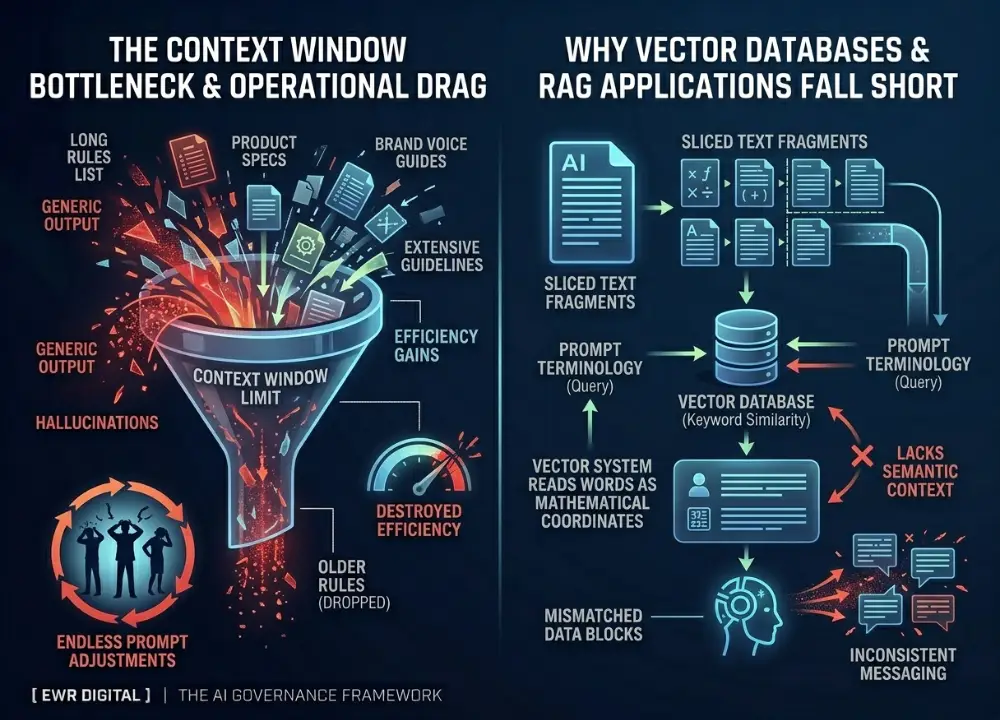
Forcing an automated tool to act like an expert by feeding it extensive guidelines creates a massive operational bottleneck. These models are restricted by limited context windows, which measure how much data they can process simultaneously. When a prompt is stuffed with long lists of rules, product specs, and brand voice guides, the system runs out of room to handle complex tasks. The machine begins to drop older rules, leading to erratic output. This issue forces your creative team into a frustrating cycle of endless prompt adjustments, destroying the efficiency gains that automation was supposed to deliver in the first place.
Why Vector Databases and RAG Applications Fall Short
To bypass the limits of prompt text volume, many technical teams use Retrieval-Augmented Generation (RAG) tied to a standard vector database. This workflow slices internal documents into smaller text fragments and pulls relevant paragraphs based on keyword similarity. However, standard RAG models lack an understanding of semantic context. They read words as mathematical coordinates rather than recognizing the actual relationships between entities. If a prompt uses slightly different terminology than your internal documentation, the vector system will retrieve mismatched data blocks, causing the model to generate inconsistent messaging that dilutes your market presence.
As enterprise knowledge bases grow exponentially, relying entirely on raw, unguided prompt engineering creates severe data fragmentation, making the systematic integration of structured semantic architectures essential for brand consistency.Gartner Enterprise Technology Insights
The Solution: Feeding Your Models With an Agency-Level Knowledge Graph
To eliminate automated distortion and build a scalable content engine, enterprise brands must transition from unstructured text repositories to an Agency-Level Knowledge Graph. A knowledge graph is a specialized, multi-dimensional data framework that maps explicit relationships between distinct real-world entities, such as your executives, your specific products, your proprietary methodologies, and your target industry verticals. Instead of saving information in isolated paragraphs, a graph organizes your data into clear semantic triplets: subject, predicate, and object.
By transforming your corporate history, service parameters, and brand voice rules into an interconnected graph, you create an external brain that models can access instantly. When an internal application or an external search engine crawler queries your firm, it no longer has to guess how your solutions fit together. The graph provides a mathematically precise map of your corporate identity, serving as a reliable data foundation for all text generation tasks.
How Structural Data Interconnection Solves the Commodity Copy Problem
When an enterprise framework guides a language model, the machine stops guessing which word should come next. The system accesses the exact facts, verified client metrics, and regulatory compliance rules required for the task. This access changes the output from generic web copy into a sharp, highly technical analysis that accurately reflects your brand identity. It allows your marketing team to scale production across multiple channels without risking the quality drops that alienate buyers and lower your search click-through rates.
This organized structure is just as critical for external search performance as it is for internal applications. Modern search engines use advanced algorithmic pipelines to identify entity authority before selecting featured snippets or generating answers for Google’s AI Overviews. If your digital footprint is connected through an optimized knowledge map, web crawlers can easily index your material as high-value reference text, cementing your position at the top of the search results page.
Technical Edge: How EWR Digital Architectures Your Structural Data Foundation
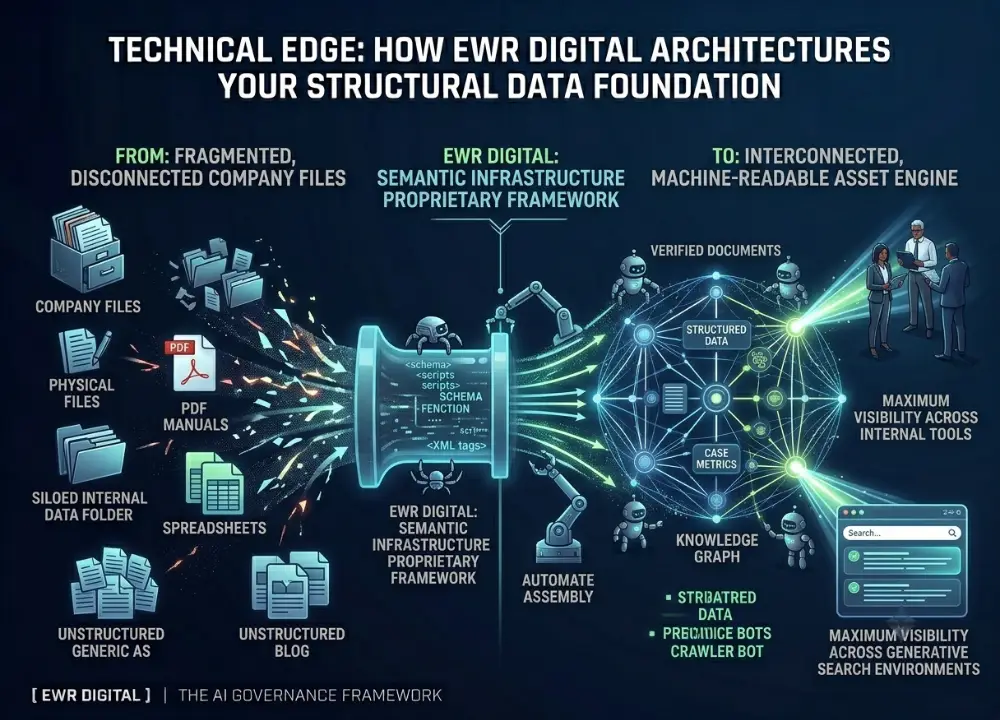
Building a robust semantic infrastructure requires deep data expertise and a clear, disciplined execution roadmap. EWR Digital has developed a proprietary engineering framework that transforms disconnected company files into an interconnected, machine-readable asset engine, ensuring your brand achieves maximum visibility across both internal tools and generative search environments.
The Three Pillars of Machine-Readable Brand Data
Our implementation process is built on three core pillars designed to guarantee long-term data accuracy and prevent automated fragmentation:
| Pillar | Technical Execution Method | Enterprise Performance Benefit |
|---|---|---|
| Semantic Extraction | Translating raw corporate assets and manuals into structured schema scripts. | Eliminates informational inconsistencies across fragmented channels. |
| Entity Alignment | Linking key executive bios, products, and case metrics via standardized graph nodes. | Forces AI models to display accurate corporate capabilities every time. |
| Continuous Validation | Using automated crawlers to check public LLM interpretations for accuracy. | Protects market reputation from algorithmic hallucinations and distortion. |
By managing your data footprint as a disciplined corporate asset, we bridge the gap between human creativity and machine processing. This advanced architecture ensures that your structured data, active ad campaigns, and social media channels all broadcast a harmonized narrative. When AI crawlers encounter this unified footprint, they recognize your deep authority, keeping your brand protected from distortion across every dark funnel research channel.
Ready to Scale Your Brand Authority Without Losing Your Soul?
The solution to internet saturation is not to generate more noise; it is to deliver unmistakable, structured authority. Continuing to rely on unguided prompting will only train your audience to ignore your content. You can achieve massive digital scale while keeping the creative distinction and expert insights that capture enterprise market share. Partner with the agency that bridges advanced algorithmic data structure with elite corporate execution. Stop publishing commodity text and start dominating generative search environments by scheduling a diagnostic discovery session with EWR Digital today.
Enterprise AI Optimization Metric: Targeted database industry audits reveal that while 82% of enterprise companies have launched internal generative intelligence programs, organizations that deploy centralized, graph-based data architectures achieve an 84% reduction in model hallucinations alongside a 3x increase in content distribution velocity compared to teams using manual prompt engineering. Source: Forrester Research Index

Matthew (Matt) Bertram helps energy and industrial companies get found, trusted, and chosen as AI reshapes how buyers decide. As owner and CEO of EWR Digital, he leads the agency's AI search and SEO work for oil and gas and other capital-intensive industries; he is also President of ModalPoint. He is also Chief Marketing Officer of the Oil & Gas Global Network (OGGN) and the author of multiple books, including LLM Visibility: A Decision-Grade System for Winning AI-Mediated Discovery and the co-authored Oil & Gas Sales & Marketing: The Energy Growth Playbook for Oil and Gas Leaders. He is a member of the American Petroleum Institute's Houston Chapter and the International Association of Privacy Professionals (IAPP).