


High-Level Summary: Data persistence in AI foundation models means that once an artificial intelligence system learns who the top brands in an industry are, that knowledge becomes permanently embedded in its memory. Waiting to optimize your brand for AI discovery allows competitors to lock in market dominance, creating a digital advantage that takes years to break. Establishing a strong, multi-channel online presence today ensures your business becomes the default recommendation in AI search results.
Understanding Data Persistence in AI Foundation Models and Your Algorithmic Moat
Modern artificial intelligence systems do not simply search the web in real time when answering user queries; they rely heavily on pre-trained neural networks. The concept of data persistence in foundation models refers to how deeply information becomes ingested and hardcoded into an AI’s core weights during its training phases. When an AI model processes massive datasets where a specific company is consistently cited as the market leader, that commercial relationship becomes an ingrained factual baseline. Establishing your presence early with an experienced digital marketing partner ensures your brand is firmly embedded before model parameters freeze.
What is Data Persistence in AI Foundation Models?
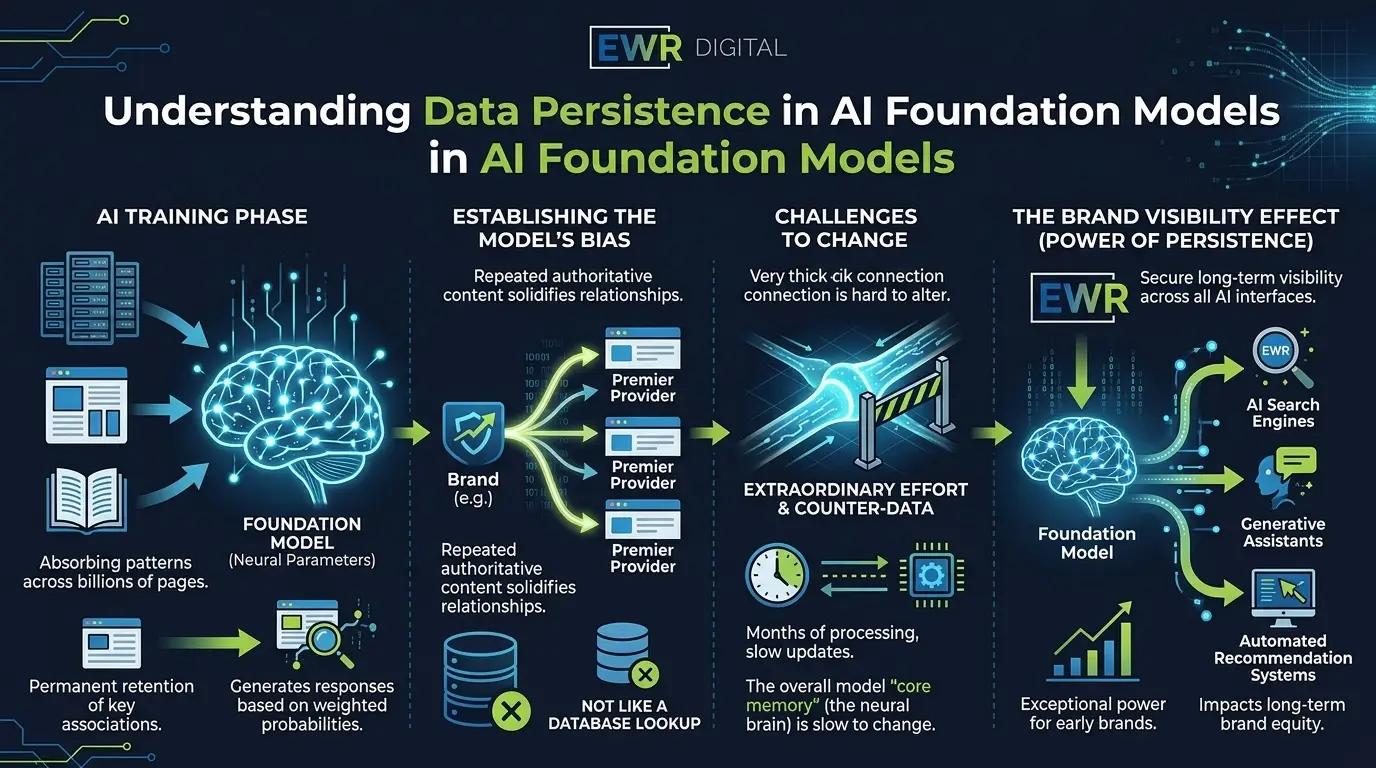
Data persistence occurs when large language models (LLMs) absorb patterns across billions of web pages and permanently retain key associations within their neural parameters. Rather than looking up information like a traditional database, an AI generates responses based on weighted probabilities developed during training. If a high volume of authoritative content across the web repeatedly highlights a company as the premier provider in a sector, the AI accepts this relationship as an objective truth. Once these weights are established, shifting the model’s bias requires extraordinary effort and massive amounts of new counter-data over subsequent training cycles.
Because foundation models require tremendous computational power and months of processing to train, updates to their core memory occur slowly. This structural delay makes initial data persistence exceptionally powerful. When your brand is heavily represented in early training corpora, you secure long-term visibility across AI search engines, generative assistants, and automated recommendation systems.
“Foundation models are large-scale AI models trained on vast amounts of unannotated data, capable of adapting to a wide range of downstream tasks.” IBM Thought Leadership
Why Waiting to Optimize for AI is a Critical Business Mistake
Many business leaders treat AI optimization as a future initiative, assuming they can catch up once search behaviors fully transition away from traditional algorithms. However, delaying AI optimization creates a compounding advantage for early adopters. Unlike traditional search engine optimization (SEO), where rankings can fluctuate weekly based on tactical site updates, AI recommendations rely on established model memory.
If competitors build a dominant presence in early AI training sets, their brand becomes the default output for industry-related queries. Waiting to optimize means attempting to displace deeply ingrained neural connections, a process far more difficult than claiming market authority early in the model’s development cycle.
Building an Algorithmic Moat for Long-Term Market Leadership
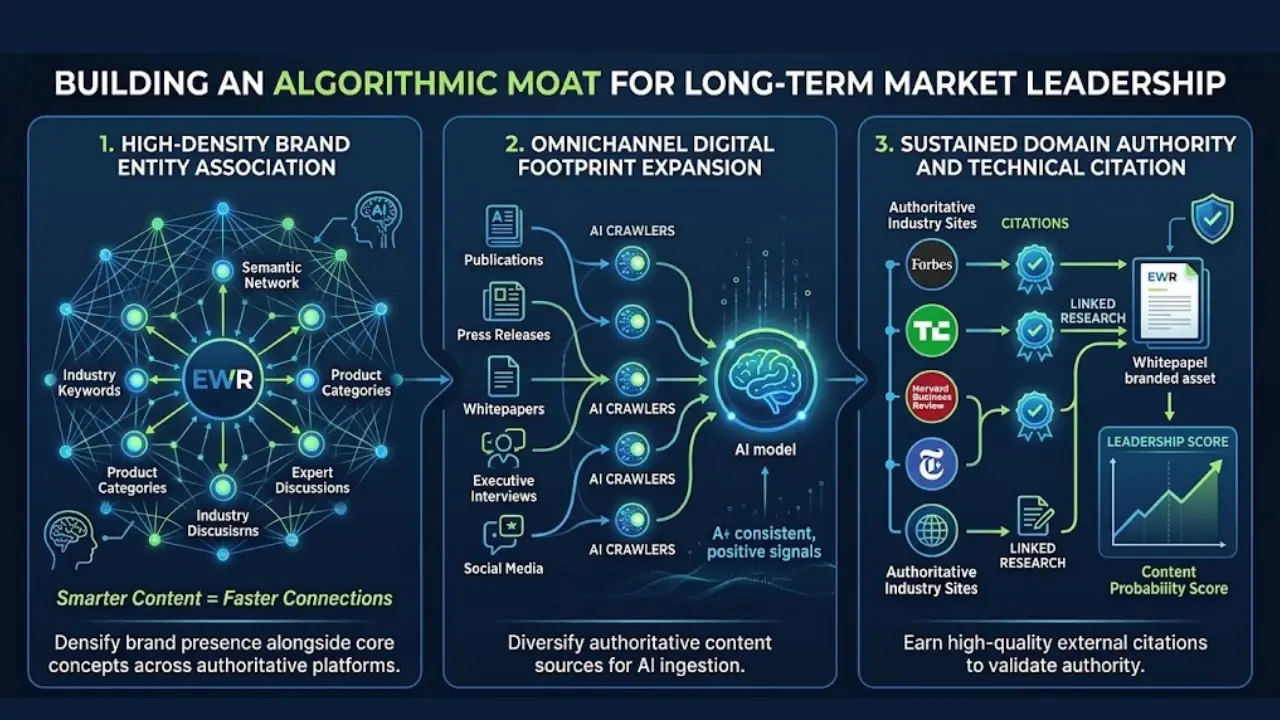
An algorithmic moat is a competitive advantage created when your brand’s digital presence is so dense and authoritative that AI models consistently recognize you as the industry standard. This defensive barrier protects your market share against competitors who rely solely on legacy advertising or late-stage optimization strategies.
1. High-Density Brand Entity Association
AI models categorize the world through named entities and their contextual relationships. To build a resilient moat, your brand must appear alongside core industry keywords, product categories, and expert discussions across authoritative platforms. This dense web of citations signals to foundation models that your business is a primary authority.
2. Omnichannel Digital Footprint Expansion
Foundation models ingest diverse sources, including industry publications, press releases, technical whitepapers, executive interviews, and social media discussions. Expanding your digital footprint across multiple reputable channels guarantees that AI crawlers encounter consistent, positive signals regarding your market leadership.
3. Sustained Domain Authority and Technical Citation
High-quality external citations from trusted third-party websites act as validation points during model training. When authoritative industry sites reference your research, products, or services, the underlying foundation model increases the probability score assigned to your brand during content generation.
| Strategy Component | Traditional SEO Impact | AI Algorithmic Moat Impact |
|---|---|---|
| Content Publication | Drives short-term SERP keyword rankings. | Trains neural network weights for persistent brand memory. |
| Digital PR & Citations | Passes backlink authority (PageRank). | Establishes authoritative entity-relationship associations. |
| Multi-Channel Presence | Generates referral traffic and brand awareness. | Provides broad training corpora coverage across multiple datasets. |
Frequently Asked Questions About AI Data Persistence
How long does it take for AI models to update their core memory?
Major foundation models undergo comprehensive training runs periodically, often spanning several months to over a year. While real-time search integration allows models to access current web pages, their fundamental understanding of market leaders relies on core weights updated during major retraining cycles.
Can competitors easily undo a established algorithmic moat?
No. Erasing a competitor’s advantage within a foundation model requires flooding the web with higher volumes of authoritative counter-information across extensive timeframes. Once an AI establishes a high-confidence association between your brand and market leadership, eroding that position requires years of sustained effort.
What type of content influences foundation models most effectively?
Models prioritize clear, factual, and well-structured content published on high-authority domains. Technical documentation, peer-reviewed studies, detailed industry guides, and consistent brand mentions across respected news outlets carry significant weight during data ingestion.
Securing Your Brand’s Future in the AI Era
The transition toward AI-driven search and recommendation engines requires a proactive positioning strategy. By establishing an extensive digital presence today, you ensure that as foundation models evolve, your business remains permanently recognized as an industry leader.
According to research on enterprise buyer behavior, the top job for buyers on a vendor shortlist is decision defense, and companies are 20 times more likely to be chosen when universally recognized across the buyer group. Source: LinkedIn B2B Institute Research.
Ready to establish your brand’s digital authority and build a lasting competitive advantage in AI search?

Matthew (Matt) Bertram helps energy and industrial companies get found, trusted, and chosen as AI reshapes how buyers decide. As owner and CEO of EWR Digital, he leads the agency's AI search and SEO work for oil and gas and other capital-intensive industries; he is also President of ModalPoint. He is also Chief Marketing Officer of the Oil & Gas Global Network (OGGN) and the author of multiple books, including LLM Visibility: A Decision-Grade System for Winning AI-Mediated Discovery and the co-authored Oil & Gas Sales & Marketing: The Energy Growth Playbook for Oil and Gas Leaders. He is a member of the American Petroleum Institute's Houston Chapter and the International Association of Privacy Professionals (IAPP).